🌱 Natural and Organic Cosmetics – From Certification Strategy to Formulation Success
 “Certification is a strategic asset as it builds credibility and trust, enhancing the brand value beyond regulatory compliance.”
Understanding Natural and Organic Cosmetics Certification to Make Better Formulation, Claims and Certification Decisions
Navigating the world of natural and organic cosmetics is more complex than ever. With evolving consumer expectations, tightening regulations, and a proliferation of certification standards, brands and formulators face a daunting landscape.
In this comprehensive guide, I’ll break down the nuances of natural and organic cosmetic certification, drawing on my 20 years of global industry experience and insights from a recent masterclass webinar.
Whether you’re a brand owner, formulator, or regulatory professional, this post will equip you with actionable strategies to achieve certification success and avoid costly pitfalls.
Understanding the Natural and Organic Cosmetics Certification Landscape
Common Questions—and Why the Answers Matter
Before diving into the technicalities, let’s address the most frequent questions I encounter:
- Can I use ISO 16128 to claim my product is natural?
- Are natural and organic the same thing?
- Does using organic ingredients automatically make my product organic?
- Why does certification seem so complicated?
Key Insights:
- ISO 16128 can support natural claims, but it’s not a certification and has limitations.
- Natural ≠ Organic: These terms have distinct definitions and thresholds across standards and markets.
- Organic ingredients alone don’t guarantee an organic product – the entire formulation and process matter.
- Choosing a standard depends on your market, brand positioning, and certification goals.
- Complexity arises because standards like COSMOS, NATRUE, and ISO 16128 measure different things and are not harmonised.
Understanding the distinctions between natural and organic cosmetics is crucial for brands aiming to position themselves effectively in the marketplace.
Actionable Advice: Start by defining your target market and certification goal. This will guide every subsequent decision, from ingredient sourcing to labelling.
Deep Dive: The Key Certification Standards
COSMOS
What is COSMOS?
COSMOS (Cosmetic Organic and Natural Standard) is a widely recognised international certification for natural and organic cosmetics.
COSMOS certification ensures that your products meet the standards for natural and organic cosmetics, giving consumers confidence in their safety and efficacy.
- COSMOS Categories
- COSMOS Organic
- At least 95% of eligible physically processed agricultural ingredients must be organic.
- Minimum organic content requirements apply to the finished product: generally 20% for leave-on and 10% for rinse-off products, subject to standard-specific exclusions and calculation rules.
- Water and minerals are excluded from organic content calculations.
- Physically processed ingredients include materials made using approved physical processes, such as cold-pressing.
- COSMOS Natural
- No minimum organic content is required.
- Ingredients and manufacturing must comply with COSMOS requirements.
- COSMOS Organic
- Key Requirements
- Approved ingredient categories and processing methods
- Documentation, traceability, and supplier information
- Third-party review and certification.
Expert Tip:
COSMOS certification can be a valuable signal to consumers and retailers, but it requires planning and documentation from the beginning of development.
NATRUE
What is NATRUE?
NATRUE is another certification standard, with requirements focused on natural content, ingredient origin, and restrictions on synthetic substances. Exact criteria depend on the applicable standard and product formulation category.
NATRUE certification is essential for brands that want to prove their commitment to natural and organic cosmetics and appeal to environmentally conscious consumers.
- NATRUE Categories
- NATRUE Natural
- Natural-content requirements vary by product type.
- The standard emphasises maximising qualifying natural content.
- NATRUE Natural Organic
- Meets the applicable natural criteria and requires a high proportion of qualifying natural and naturally derived substances to be organic.
- NATRUE Natural
- Key Features
- Product-category-specific requirements.
- Restrictions on synthetic ingredients.
- Attention to ingredient origin and processing.
Expert Tip:
Before designing to NATRUE, confirm the current criteria directly with the certifier. Definitions, calculation methods, and eligible ingredients can differ from other standards.
ISO 16128
What is ISO 16128?
ISO 16128 is a guideline – not a certification. It provides a method for calculating the natural and organic content of cosmetic ingredients and finished products.
ISO 16128 can help manufacturers clearly label the natural and organic cosmetics content in their products, making it easier for consumers to make informed choices.
- How It Works
- Ingredients receive natural-origin and organic-origin indices, typically expressed from 0 to 1.
- Calculations can be used to estimate the finished product’s natural and organic content.
- ISO 16128 does not create a universal pass/fail threshold or require a third-party certification audit.
- Use Cases
- Internal product comparisons and development decisions.
- Supporting substantiation in markets where the method is accepted, alongside applicable claims rules.
Expert Tip:
Use ISO 16128 as a calculation framework, not as proof of certification. Keep the calculation method and supporting supplier data on file, and make sure any claim is clear and not misleading.
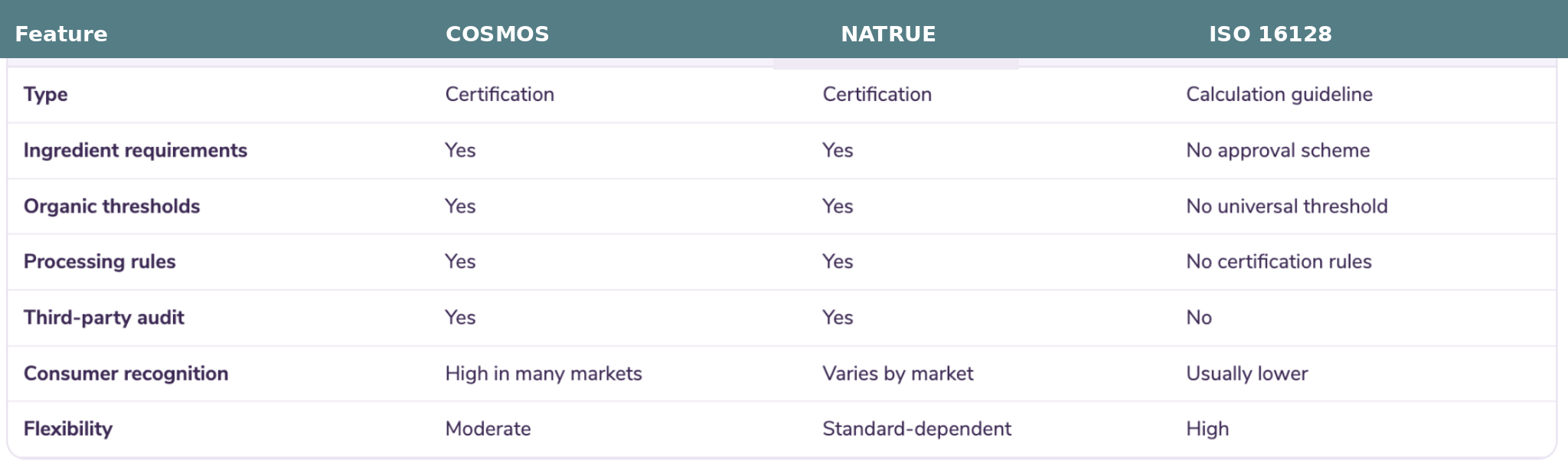
Comparing Standards: What Sets Them Apart?
When choosing between various certification standards for natural and organic cosmetics, consider how each one aligns with your brand’s values and market demands.
Actionable Advice:
Choose your approach based on the markets you intend to serve, the claims you plan to make, and your ability to meet documentation and audit requirements. For brands selling across several regions, compare retailer expectations as well as certification logos.
Applying Standards: A Real-World Formulation Example
Consider a moisturising face cream (illustrative formula):
- Water (65%)
- Organic sunflower oil (15%)
- Glycerin (5%)
- Emollients, emulsifiers, rheology modifiers, preservatives, antioxidants such as tocopherol, and natural fragrance (15%)
Natural and Organic Cosmetic Certification Assessment
COSMOS Organic Assessment
- Ingredient check: Confirm every ingredient, processing method, and manufacturing step against current COSMOS requirements.
- Organic calculation: Count only eligible organic portions using the standard’s rules. Water does not contribute to organic content. For example, the sunflower oil contributes 15% if fully certified organic; glycerin and other ingredients contribute only their eligible organic fractions.
- Result: The product may meet the finished-product threshold, but only after all ingredient data and applicable exclusions are verified. The example calculation is not a certification decision.
COSMOS Natural Assessment
- Ingredient check: Verify that each ingredient and process is permitted.
- Organic content: No minimum is required for this category.
- Result: Potentially eligible if the complete formula and production system comply.
NATRUE Assessment
- Natural content: Calculate using the relevant product-category rules and the standard’s definitions.
- Organic content: Assess the qualifying organic fraction of natural and naturally derived ingredients.
- Result: Eligibility depends on the applicable thresholds and full documentation; the formula cannot be classified from ingredient names alone.
ISO 16128 Assessment
- Ingredient check: Calculate each ingredient’s relevant index using supplier data and the chosen calculation method.
- Result: A percentage may support internal comparisons, but it does not confer certification.
Key Takeaway:
The same formula can receive different outcomes under different standards. Do not treat illustrative percentages as definitive: supplier composition, processing, water content, and calculation rules can materially change the result.
Integrating Certification into Product Development
By integrating certification for natural and organic cosmetics into your product development process, you can streamline compliance and enhance product credibility.
Why Integration Matters
Treating certification as an afterthought can lead to:
- Late ingredient substitutions
- Reformulation and testing costs
- Launch delays
- Missing documentation or audit findings
The Right Approach
Define Your Certification Target First
Identify target markets, retailer requirements, and intended claims.
Confirm which certification or calculation method is appropriate.Select Ingredients Accordingly
Check ingredient eligibility before purchase.
Request composition, origin, processing, and organic certificates from suppliers.Design Your Formula
Review every ingredient, including fragrances, preservatives, processing aids, and compound materials.
Check that the manufacturing process also meets the selected standard.Evaluate the Certification Outcome
Calculate natural and organic content using the applicable rules.
Ask the certifier to clarify uncertain ingredients or calculations before finalizing the formula.Prepare for Audit
Organise specifications, certificates, batch records, and traceability documents.
Ensure relevant staff understand the procedures they are responsible for.
- Actionable Checklist:
- [ ] Certification target defined
- [ ] Ingredient list checked against current requirements
- [ ] Supplier documentation collected and reviewed
- [ ] Formula and content calculations verified
- [ ] Manufacturing records prepared
- [ ] Internal review completed
Common Certification Mistakes—and How to Avoid Them
Understanding common certification mistakes can help brands of natural and organic cosmetics avoid pitfalls that could undermine their market position.
Assuming Natural Means Organic
Reality: Organic certification has additional sourcing, processing, calculation, and documentation requirements.
Solution: Check the chosen standard’s definitions and thresholds. Don’t infer organic status from an ingredient’s natural origin.Relying on Supplier Marketing Claims
Reality:Terms such as “green,” “plant-based,” or “naturally derived” do not automatically demonstrate certification eligibility.
Solution: Obtain current technical documentation and, where relevant, organic certificates. Confirm that documents cover the exact material, supplier, and production site used.Treating ISO 16128 as a Certification
Reality: ISO 16128 offers a calculation methodology, not a logo, audit, or pass/fail approval.
Solution: Describe calculated content accurately and keep the supporting data. Never imply that an ISO calculation equals third-party certification.Calculating Organic Content Incorrectly
Reality: Not every ingredient contributes its full weight to the organic percentage. Water, mineral ingredients, carriers, and mixtures may be treated differently.
Solution: Use the standard’s calculation rules and documented ingredient composition. Have calculations reviewed before printing packaging or submitting an application.Leaving Certification Until the End
Reality: A late review can reveal that a key emulsifier, preservative, fragrance, or manufacturing step is not acceptable.
Solution: Include certification screening at concept stage, then repeat it whenever the formula, supplier, or process changes.Overlooking Supplier and Change Control
Reality: A supplier may change a raw material’s composition or production method without the brand recognizing the certification impact.
Solution: Establish written notification procedures, retain current specifications, and reassess compliance after material changes.Making Claims Beyond the Evidence
Reality: A certified product may still be marketed in a misleading way if claims imply that every ingredient is organic or that certification proves broader environmental benefits.
Solution: Review packaging, websites, and advertising against the certification rules and local claims requirements. Keep evidence for every express or implied claim.Assuming One Approval Covers Every Market
Reality: Certification recognition and labeling rules vary across countries and retailers.
Solution: Map requirements market by market. A certification logo does not replace local regulatory review, safety assessment, or mandatory product notifications.Final Tip
Certification is a continuing compliance process, not a one-time badge. Maintain records, monitor ingredient changes, and renew certificates on schedule.
In Summary
- Review the current standard documents and guidance published by the relevant certification organisation.
- Ask prospective certifiers about eligibility, fees, timelines, and how they treat complex ingredients.
- Use ISO 16128 texts and supplier data for transparent calculations, not as substitutes for certification.
- Consult regulatory professionals for market-specific labeling and claims reviews.
- Maintain a controlled document library for specifications, certificates, formula versions, and audit records.
Conclusion: Your Roadmap to Certification Success
Ultimately, the journey toward certification in natural and organic cosmetics requires diligence and a proactive approach to ensure long-term success.
Natural and organic cosmetic certification is manageable when it is built into product development from the start. First, define your market and claims. Then select the appropriate standard, verify ingredients and suppliers, calculate content using the correct rules, and maintain traceable records. Finally, review labels and marketing materials before launch – and reassess compliance whenever the product changes.
The most important principle is to avoid assumptions. “Natural,” “organic,” “certified,” and “calculated according to ISO 16128” are not interchangeable descriptions. Understanding the distinctions helps protect your brand, supports consumer trust, and reduces costly reformulation.
The evolving landscape of natural and organic cosmetics requires brands to stay informed and adaptable to maintain consumer trust and market relevance.
With careful planning and reliable documentation, certification can become more than a final approval step: it can guide better formulation decisions and create a clearer, more credible product story.
*****
Resources for Deeper Learning
Step 1: Continue Your Learning with the FREE webinar replay:
 Natural and Organic Cosmetics Masterclass – From Certification Strategy to Formulation Success
*****
Step 2: Ready to go deeper into certification and formulation?
Natural and Organic Cosmetics Masterclass Bundle
Certification Strategy to Formulation Success
Part 1: Achieving Organic Certification Workshop
Learn how COSMOS, NATRUE and ISO 16128 differ, how certification works, and how to avoid common certification mistakes.
Part 2: Natural & Organic Cosmetic Formulation Workshop
Learn how formulation decisions influence certification outcomes and how to design certification-ready products from the beginning.